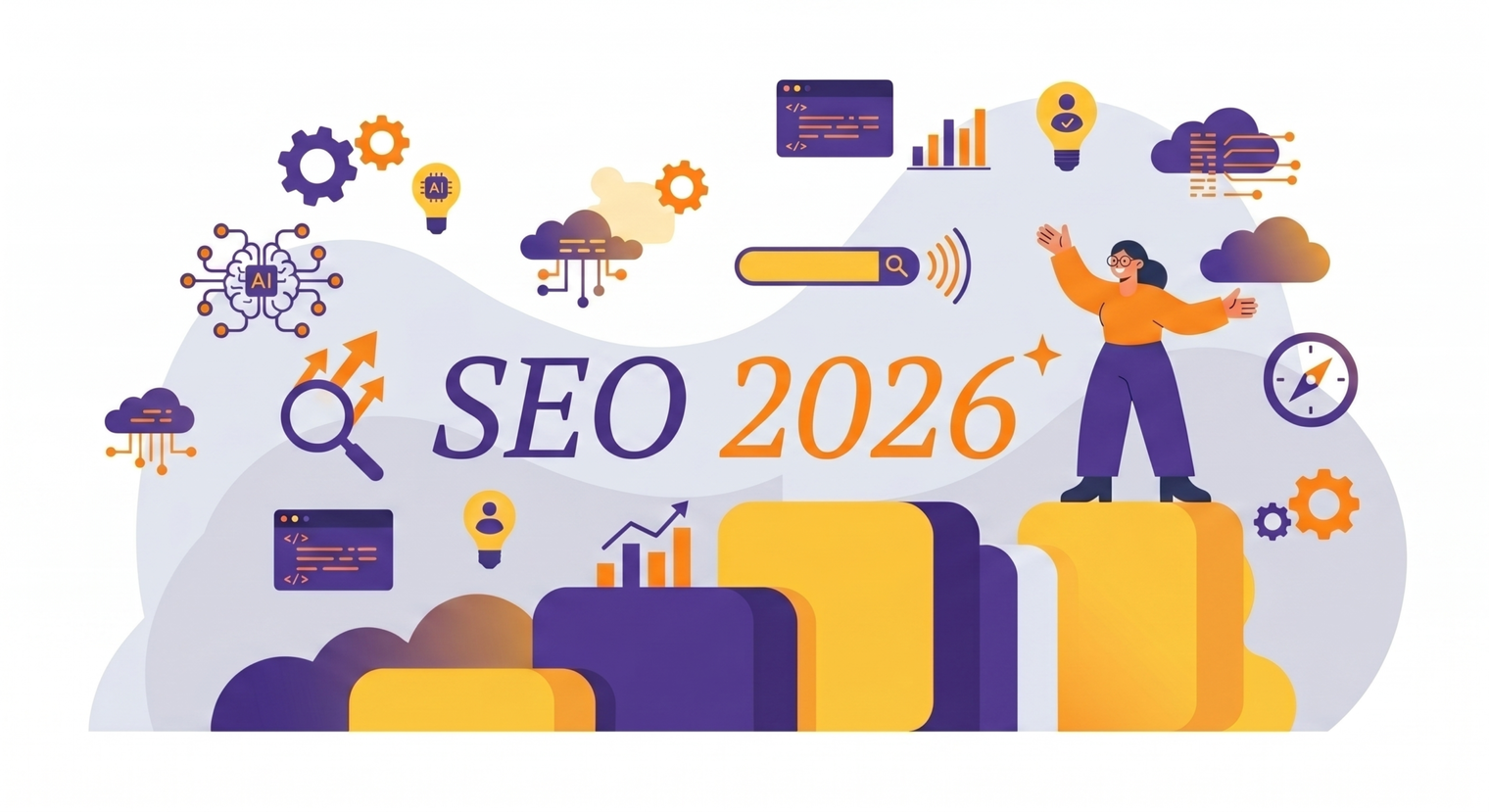
“If AI doesn’t cite you — you don’t exist. And no 2020-style SEO audit is going to fix that”
When a client says: “ChatGPT recommended you to me!”
A client from Lviv called me recently — a regular conversation: we discussed the project, deadlines, budgets, and at the end, as always, I asked — so how did you find me? I was expecting something like LinkedIn, Facebook, maybe Google… And she casually replied: “ChatGPT recommended you to me.”
I froze for a couple of seconds. Not from surprise — from a clear sense that something had shifted for good. A year ago this would have sounded like a futuristic joke. Now it’s everyday reality. Users no longer go to search engines to scroll through ten blue links. They ask AI — and they reach out to whoever AI pointed them to.
In my 18 years in development, I’ve seen plenty of “SEO revolutions”, most of which turned out to be hype and minor changes to organic ranking rules. This time it’s fundamentally different. This time the game has actually changed. And this article isn’t about the future — it’s about what’s happening to SEO right here, right now.
What’s actually going on
Let me start with a few numbers you need to accept before we get into the debate.
60% of search queries in 2026 end without a single click. The user gets the answer right in the SERP — from AI Overviews, a voice assistant, a chatbot — and goes nowhere. It’s called zero-click search, and it’s no longer a niche phenomenon.
When an AI Overview appears above the organic results, the page in position #1 loses between 35% and 58% of clicks. That’s not theory — those are measured numbers from real SERPs. Informational niches get hit hardest: in the medical vertical, AI answers show up above 47% of queries.
But there’s another side — Google grew by 20% in query volume over the past year. ChatGPT, despite all the hype, gets roughly 190 to 373 times fewer queries than Google. So search isn’t dead. It just got a new layer on top — and it’s that layer that decides whether your site or your competitor’s gets shown.
The conclusion is simple: classic SEO isn’t dying. But if you don’t understand how the AI layer above it works, your efforts evaporate before traffic ever reaches your site.
How AI actually searches: Query Fanout
Most users think ChatGPT “just knows” the answer. Like a smart encyclopedia that remembers everything — that’s a fundamental misunderstanding.
When you send AI a query, here’s what really happens: it takes your question, breaks it into 5-10 sub-queries, runs each through a regular search engine (ChatGPT — through Bing, Perplexity — also through Bing, AI Overviews — through Google’s index), grabs the pages that rank for those sub-queries, and stitches together an answer from the pieces. This is called Query Fanout.
What this means in practice:
- AI doesn’t cite “websites” — AI cites pages that rank for specific sub-queries around the topic
- The top 3 in Google are still critical, because that’s where AI pulls the foundation of its answer
- Bing suddenly matters — it feeds ChatGPT and Perplexity, the two biggest AI channels
- You need to cover the topic broadly, because there are many sub-queries and AI can pick any of them
So — nothing new, really. Google and Bing work the way they always worked. There’s just a new AI layer above them now — and you need to be visible not only in the SERPs, but there too.
A client case: when old SEO breaks the site
Let me start from the opposite end — with what you should NOT do. Because I see this constantly: clients show up with “optimizations” that worked 10 years ago, and now their site is getting punished for those very same things.
A real story: a client came to me after he had already worked with an “old school” SEO agency. They had recommended a “great thing” — to automatically generate a block of links to internal pages on every page of the site, supposedly for internal linking. The site had hundreds of pages — and the same block, with the same links, appeared on every single one of them, with no context, no logic — just interlinking for the sake of interlinking.
I looked at this proposal and told the client straight up: this is spam. Google knows how to distinguish natural interlinking from auto-generated link spam, and if it sees this kind of construct on thousands of pages, it will absolutely penalize the site. Because to a crawler this looks like an attempt to manipulate rankings, not to help it.
The client listened, thought about it, and… implemented it anyway. Because those SEO guys spoke with confidence, they had “case studies”, “experience”, “methodologies”. After some time, the site’s traffic started slipping 💁 not sharply — gradually, but steadily. We urgently removed that block, and the client parted ways with that SEO company. And he started trusting my recommendations, even when they contradict “generally accepted practices”.
This isn’t an isolated case, it’s an epidemic. Everything that worked in 2010-2015 — mass interlinking, keyword-stuffed anchors, texts with shoehorned phrases, “buy cheap” buttons in every possible variation — today, that’s shooting yourself in the foot. Not neutral, not “doesn’t help”, but actively harmful.
Schema.org: the invisible foundation that suddenly became critical
Now — about what works. First and most important: structured data, or microformats, or schema.org. Call it whatever you want, the essence is the same.
On my current site, I implemented schema right when I built it. I didn’t just start doing this in 2026 — microformats mattered before too, I always understood this is the language a site uses to talk to machines. Back then the machine was just Google. Now there are more machines — ChatGPT, Claude, Gemini, Perplexity. And they all read the same structured data.
On WordPress, the basic minimum that should be on every site in 2026:
- Article / BlogPosting — for blog posts, with datePublished and dateModified fields
- Author — a separate schema for the author, with links to their profiles and credentials
- Organization — for the company itself, with logo, contacts, sameAs links to social media
- BreadcrumbList — the navigation path that AI uses to understand structure
- FAQ / HowTo — where appropriate (not everywhere — Google penalizes schema spam)
- AggregateRating — for commercial pages with reviews
And one more thing many people miss. Schema.org isn’t a plugin you install and forget. It’s systematic work: markup must match the actual content of the page, be valid against the standard, and update along with site changes. Otherwise Google reads the inconsistency and just ignores the entire markup.
llms.txt: the new standard most people haven’t caught on to yet
The next level is llms.txt. This is a new standard, an analog of robots.txt but for AI models. In this file you give AI crawlers structured information about your site: what it’s about, which pages matter most, how to parse the content.
This is what I’m actively starting to implement on all of my sites and all client projects right now. Rolling out llms.txt is forward-looking work — the standard is still young, not all AIs fully respect it yet, but the direction is clear. In a year or two, sites without llms.txt will be like sites without robots.txt in 2010 — technically working, but looking amateurish.
How to configure robots.txt for AI crawlers is a separate story of its own. The key players right now:
- GPTBot — the main OpenAI crawler (indexing for ChatGPT)
- ClaudeBot / Claude-Web — Anthropic’s crawler
- PerplexityBot — Perplexity’s crawler
- Google-Extended — a separate token for Bard/Gemini that you can block while still allowing Googlebot
- OAI-SearchBot — a separate bot for SearchGPT
Here we run into an interesting dilemma. Block them — AI won’t cite you, your content falls out of the answers. Allow them — AI may use your content and push you out of the organic results. My position: for a content site (blog, educational portal, product with public marketing) — allow. For closed B2B knowledge bases, documentation, unique proprietary data — block. It’s case by case.
Headless WordPress: reality vs hype
A separate topic where there’s a lot of speculation around AI Search right now. The pitch is: for an AI-friendly site, you absolutely need Headless WordPress, SSR, static generation, a React front-end, something trendy.
Honestly — I don’t quite get the hype. The argument from the supporters: AI crawlers love clean HTML without JavaScript bloat, without render delays, with fast response. All correct. I just don’t see how a properly built classic WordPress falls short of that.
All of my WordPress sites have a response time under 100 ms. That’s achieved not by Headless architecture, but by a normal approach to development: an optimized theme without unnecessary dependencies, proper caching at the Nginx and WP level, optimized database queries, a CDN for static assets, image compression in WebP/AVIF. The site performs like Headless — without being Headless.
Headless makes sense where it’s actually needed:
- Multi-platform projects — when WordPress content feeds the site, a mobile app, and a marketplace simultaneously
- Complex frontends — interactive apps on React/Next.js, where WP serves as a backend CMS
- Large content projects — where SSR/SSG gives a scale advantage
For a regular blog, a brochure site, or a corporate site, Headless is overkill. Complexity multiplies, the entry barrier for the client (who has to manage the content) goes up too, and the speed gain is zero if your regular WP is already fast.
I’m rolling out SSR/SSG where it makes sense. But I don’t see it as a cure-all for AI visibility. It’s a tool, not a silver bullet.
How to write content so AI cites you
Now — about content. Because a technical foundation without the right content gets you nowhere.
Three things that actually work in 2026:
Answer-First Architecture. A direct answer to the query — in the first two paragraphs of the page. No warm-up, no “let’s consider the context”, no preamble about how important the topic is. AI parses the beginning and looks for a ready answer. If it’s there — it cites you. If not — it goes to the competitor who delivered the answer immediately.
Fact density — facts per paragraph. The era of “2000-word articles full of fluff” is officially over. AI calculates the ratio of useful information to total text volume. Concrete numbers, concrete examples, concrete statements. Every sentence delivers value — or it gets cut.
Topical Authority — cluster structure. Not one article about “SEO in 2026”, but 15-20 pieces covering every sub-topic: schema, llms.txt, AI Overviews, Core Web Vitals, headless, query fanout, case studies. With natural internal linking between them. The site becomes an authority on the topic as a whole, not on one keyword.
By the way, on my educational portal edu.kaplia.pro I have a detailed piece on best SEO practices for WordPress in 2026. And here’s an interesting fact: that exact page ranks best out of everything on the portal and gets the most views. Not by accident — it’s built on the very principles I’m describing here. Specifics from the first paragraph, facts in every paragraph, dense topic coverage. AI recognizes and cites it well.
I haven’t yet brought my own topical architecture to the level I want. That’s the next step — fully restructuring edu.kaplia.pro as a set of topical clusters with a clear hierarchy of money pages → cluster pages → supporting content. I’ll show the process in upcoming posts.
Gray practices: why I never recommended them and never will
A separate big topic I can’t avoid. In SEO communities, there’s constant chatter about “gray” methods: CTR manipulation, PBNs, expired domains, LLM PBN, parasite SEO on trusted platforms, gaming Bing to land in the ChatGPT “consensus”.
All this sounds very professional, with case studies, with numbers, with promises. The pitch: “white-hat SEO isn’t enough, you need to use the full arsenal”.
My position is short — this is a road to nowhere. If your target is Google and Western AI systems (and in the Ukrainian and European internet, there really is no other target), then any “gray” hacks will eventually catch up with you. And it’ll cost more than everything you “saved” with those hacks.
Specifically:
- Google knows how to detect manipulation. Anti-fraud systems check real devices, click geography, behavioral patterns. Catching the manipulation costs less than running it.
- Negative SEO in Google. Within 2-3 days of being hit with short-click manipulation, sites drop out of the top 100. Recovery is practically impossible.
- PBNs built on expired domains are a short-term hack. Yes, a domain with history gives a signal. Yes, you can buy one for $1,500 and place a link. And yes, Google regularly finds these networks and shuts them down en masse.
- LLM PBN is purely experimental. Spamming ChatGPT by building a network of sites to land in the “consensus” — it’s expensive, of dubious effectiveness, and the first model updates will zero it out.
You can pick the short-term hack — get a quick result, wait for the penalty, and start over from scratch. Or you can build a white-hat, slow, stable foundation — one that doesn’t take off in a week, but then keeps working for years.
It’s the same paradox I described in the article The Lexus on LPG Paradox. Cheap fuel in an expensive car. Only here it’s cheap gray methods in an expensive business that could have grown for 10 years but dies two months after the next algorithm update.
So what’s hype here, and what’s reality
Let me be honest — there’s a lot of overhype in the whole AI Search story. For most people, “AI + SEO” sounds sweet, like a new field to invest in.
My take: the foundation hasn’t changed. Microformats were important before — they’re just being used more now, as intended. Structured data, quality content from an expert, technical speed, topical depth — all of this worked 10 years ago, works now, and will work 5 years from now. There are just new consumers of those signals — AI systems alongside search engines.
What’s genuinely new:
- AI Overviews take clicks away — you have to accept it and work within the new conditions
- Branded mentions matter more than classic backlinks for AI visibility — Reddit, YouTube, listicles, niche forums
- Zero-click is becoming the norm — meaning the fact of being cited matters more than the visit itself
- llms.txt and AI-friendly architecture — new technical standards worth implementing
The rest is evolution of what was already there. Brand mattered, now it’s critical. Author expertise was nice-to-have, now it’s mandatory. Speed mattered, now it matters more. Not a revolution. Just a higher bar for quality.
So what’s next?
SEO in 2026 is growing up — it’s a quantum leap. Same as WordPress, same as the entire developer profession, same as the market as a whole.
Whoever still thinks “install a theme, fill in the content, get traffic” — they’re out of the game. Whoever understands that the site must be technically flawless, the content must be expert, the structure must be deliberate, and the presence must be cross-platform — they’re winning. And they’ll keep winning for a long time.
Calls from clients saying “ChatGPT recommended you” — that’s a signal. Quiet for now, but getting louder. In a year it’ll be every third client. In two — every other one. The question isn’t whether to step into the new reality. The question is whether you’ll make it in time or miss the boat.
If your site still lives by 2018 rules — it’s time to look at it with fresh eyes. Schema, llms.txt, speed, content structure, real author expertise, removing old “clever” blocks from SEO’s past. If you realize you don’t know where to start with all this — get in touch. I’ll run an audit, point out the weak spots, build a transition plan.
Because when a client in 2027 asks “How did you find me?” — you want the answer “ChatGPT recommended you” to be about your business, not your competitor’s.